Rolex Day-Date, a guide to the watch known as the President
Some watches tell the time. Others make a statement about status. The Rolex Day-Date clearly belongs in the second group. Since 1956, it has been linked with heads of state, business leaders and major figures in sport and the arts.
Behind its prestigious image, though, the watch is more complex than it looks. Two sizes, four precious metals, dozens of dials and several generations of movements make the choice harder.
This guide explains where the "President" nickname comes from, compares the Day-Date 36 and the Day-Date 40, covers the most sought-after materials and dials, and reviews prices in Canada.
The history of the Rolex Day-Date and its President nickname
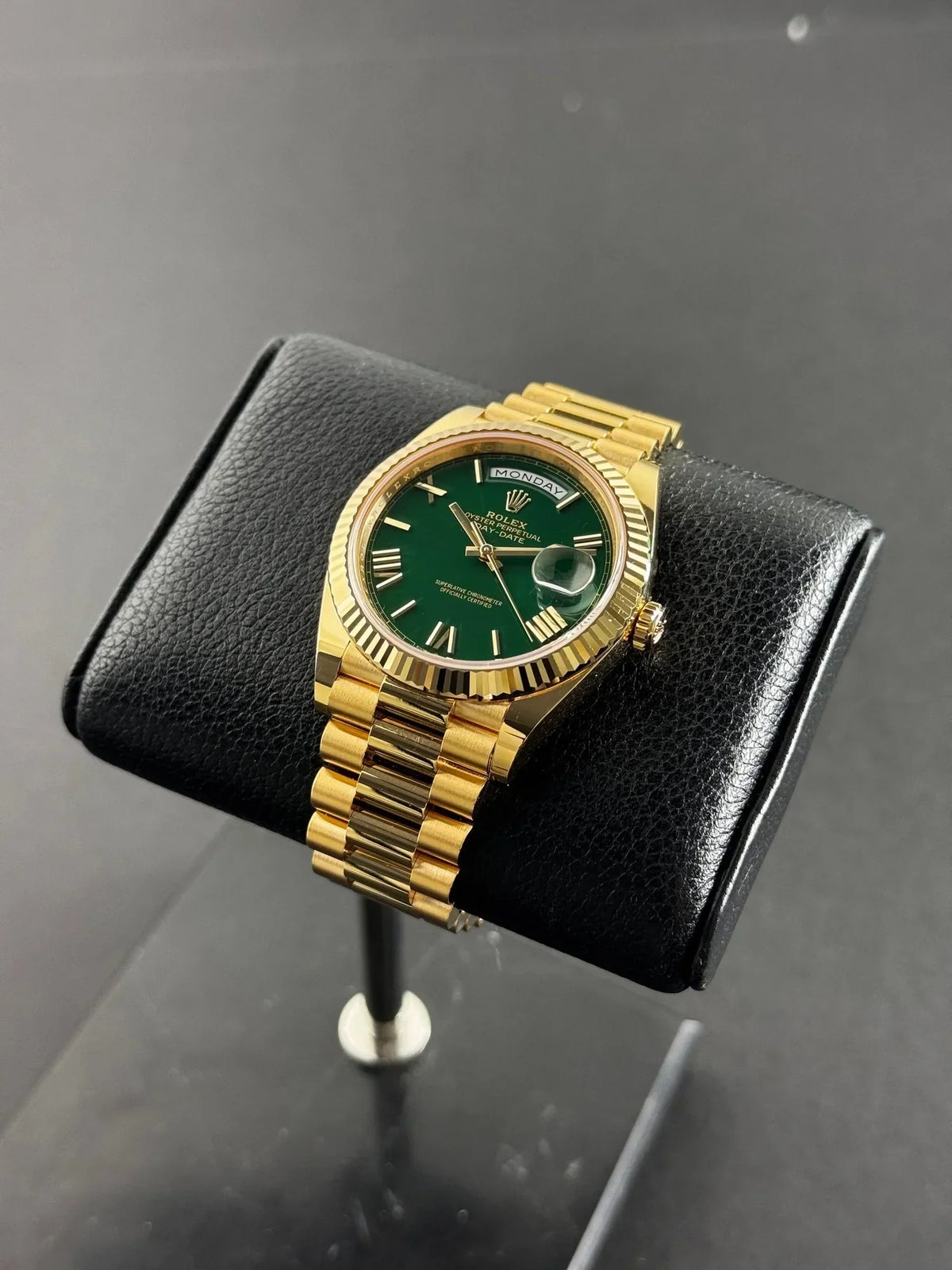
The Day-Date was launched in 1956, 11 years after the Datejust. According to Rolex's official page on the Day-Date's features, it is the only watch that displays the day of the week spelled out in full, in addition to the date, in a choice of about twenty languages.
The day appears at 12 o'clock in an arc-shaped window, while the date sits at 3 o'clock under the Cyclops lens. The change from one day to the next happens almost instantly at midnight, thanks to a system of interconnected discs. Over the decades, the watch has become more technically advanced without ever giving up its original formula.
Where the "President" nickname comes from
The President bracelet was designed specifically for the launch of the Day-Date. Its evocative name, combined with the many political leaders who have worn the model, eventually gave the watch itself its nickname. Today, enthusiasts often say Rolex President when they mean the Day-Date.
Day-Date 36 or Day-Date 40, the two sizes
The Day-Date comes in two diameters. The choice depends as much on wrist size as on the style you want.
The Day-Date 36 keeps the model's historic diameter. Understated and elegant, it suits most wrists and appeals to men and women alike. It is also the most common size on the pre-owned market, thanks to its many generations.
The Day-Date 40, introduced in 2015, has a more contemporary look. It replaced the 41 mm Day-Date II and suits larger wrists. Both sizes are now powered by the calibre 3255, a movement developed and manufactured by Rolex, with a power reserve of about 70 hours.
Previous generations of the Day-Date 36
On the pre-owned market, the Day-Date 36 comes in several generations. Four-digit references, such as the 18038, came before the 18238 and then the 118238, followed by the current generation, including the 128238 in yellow gold. Each generation brought changes to the movement, crystal or bracelet. Older models appeal with their vintage charm and more accessible price, while newer ones offer modern reliability and a longer power reserve.
|
Diameter |
36 mm |
40 mm |
|
Current movement |
Calibre 3255 |
Calibre 3255 |
|
Profile |
Classic, unisex |
Contemporary, more presence |
|
Pre-owned market |
Wide choice of generations |
More recent references |
|
Ideal wrist |
Slim to medium |
Medium to large |
A watch made only in precious metal
This is one of the Day-Date's most important features: it has never been made in steel. It is offered only in 18 ct gold and 950 platinum.
Rolex casts its own gold alloys in its in-house foundry. Rolex's page on its materials presents these alloys, including Everose, a rose gold whose colour is designed to last.
On the wrist, a gold Day-Date is noticeably heavier than a steel Rolex. Many owners see the weight as part of the experience, but it is worth trying the watch on before you decide, especially when choosing between gold and platinum, which is even denser.
Here are the four metal options and their character:
- Yellow gold: the most classic version, often paired with the champagne dial and the President bracelet.
- White gold: more discreet, it looks like steel at first glance but has the weight and prestige of gold.
- Everose gold: a warm rose tone, popular with chocolate or olive dials.
- Platinum: the rarest metal in the collection, recognizable by its ice blue dial, reserved for platinum models.
The most sought-after Day-Date dials
The Day-Date offers a wide variety of dials. Some are especially coveted by collectors and have a direct effect on market value.
The champagne dial, the great classic
Paired with yellow gold and the President bracelet, the champagne dial represents the most traditional image of the Day-Date. It is also an easy configuration to resell, thanks to steady demand across several generations.
The olive dial
Olive green has become one of the Day-Date's modern signatures. Offered on Everose gold and white gold versions, often with Roman numerals, it adds an original touch to a watch that is usually more classic.
Stone dials and diamond hour markers
Rolex also offers dials in ornamental stones, such as onyx or aventurine, as well as diamond-set hour markers. These rarer configurations are aimed at collectors looking for a distinctive Day-Date. They call for especially careful inspection on the pre-owned market, since modified or non-original dials do exist.

The President bracelet, an essential element
The President bracelet is made of three-piece semi-circular links, produced only in 18 ct gold or platinum. It is reserved for the Day-Date and the precious metal versions of the Datejust.
On the wrist, it feels supple and comfortable, and is much heavier than a steel bracelet. Recent models have a Crownclasp, hidden under the bracelet to keep the design visually seamless.
The price of the Rolex Day-Date in Canada
At retail, the Day-Date is one of the most expensive watches in the current Rolex lineup, because it is made only in precious metal. GST and QST are added to the list price.
On the pre-owned market, prices depend on several factors: the metal, the size, the dial, the movement generation and whether the box and papers are included. Previous-generation 36 mm yellow gold versions are often among the most accessible options, while platinum models and rare dials reach the highest prices.
This guide explains how to buy a Rolex without a waiting list in Montreal. For buyers who see the Day-Date as an investment, this guide to investing in a luxury watch covers the criteria to assess and the risks to know.
Checking authenticity before you buy
A gold Day-Date is a major purchase. The reference, serial number and documents must match, and the precious metal hallmark and dial should also be checked. This guide to getting a Rolex authenticated walks through the professional appraisal process.
Rolex Day-Date, a classic worth its weight in gold
The Day-Date brings together everything that built Rolex's reputation: historic innovation, noble materials and a design that has kept its authority for nearly 70 years. Making the right choice comes down to three decisions: the size, the metal and the dial.
A well-chosen Day-Date can be worn for a lifetime and is often passed down from one generation to the next. For owners who would rather resell or trade their watch, this guide explains how to sell your Rolex at a fair price in Montreal.
Frequently asked questions about the Rolex Day-Date
Why is the Rolex Day-Date called the "President"?
The Rolex Day-Date is called the President because of its bracelet, which was named President when the model launched in 1956. That name, combined with the many heads of state and leaders who have worn the watch, eventually came to refer to the Day-Date itself. Today, most watch enthusiasts around the world use Rolex President and Day-Date interchangeably.
What is the difference between the Day-Date and the Datejust?
The main difference lies in the display and the materials. The Day-Date shows the day of the week spelled out in full in addition to the date, while the Datejust shows only the date. The Day-Date is also made exclusively in gold or platinum, whereas the Datejust is available in steel and Rolesor. The Day-Date sits one step higher in the range.
Is the Day-Date 40 a good investment?
The Day-Date 40 generally holds its value well, thanks to its precious metal and strong demand for Rolex. Some configurations, such as olive dials or platinum versions, are especially sought after. Still, no watch guarantees a return. It is best to buy it first for the pleasure of wearing it and to treat resale value as a bonus.