Luxury watch polishing, when to do it and when to hold off
Key takeaway: Luxury watch polishing is ideally done during a complete service, when the case is already disassembled and water resistance will be tested. Every pass removes metal: Audemars Piguet advises no more than three to five refreshes over a watch's lifetime. Hold off on a vintage piece or before a sale.
On the service price list that Rolex publishes for Canada, luxury watch polishing takes up a single line: "Polishing and satin-finishing of the case and bracelet," $210 CAD, optional, and only as part of a complete service. Checked in October 2026, that line contains almost the whole answer.
Optional, because the manufacture itself does not require it. Tied to the complete service, because that is when the case is fully disassembled.
Every polish draws on a limited reserve of metal
In brief: Polishing removes a scratch by lowering the entire surface around it, which turns the number of passes into a budget to manage.
A scratch cannot be filled in. To make it disappear, the polisher wears down the metal all around it until reaching the bottom of the groove. On a flat surface, the operation goes unnoticed. On an edge, it rounds it off a little more each time.
Audemars Piguet gives precise figures on its servicing page. The case and bracelet of a Royal Oak have 24 bevelled edges, 27 surfaces with different finishes (polished, sandblasted, satin-brushed) and 16 screw heads. The manufacture recommends no more than three to five cosmetic refreshes over the watch's life cycle.
That limit comes from a brand that polishes its own watches: it serves as a benchmark for any case with sharply defined edges.
Workshops distinguish three levels of intervention:
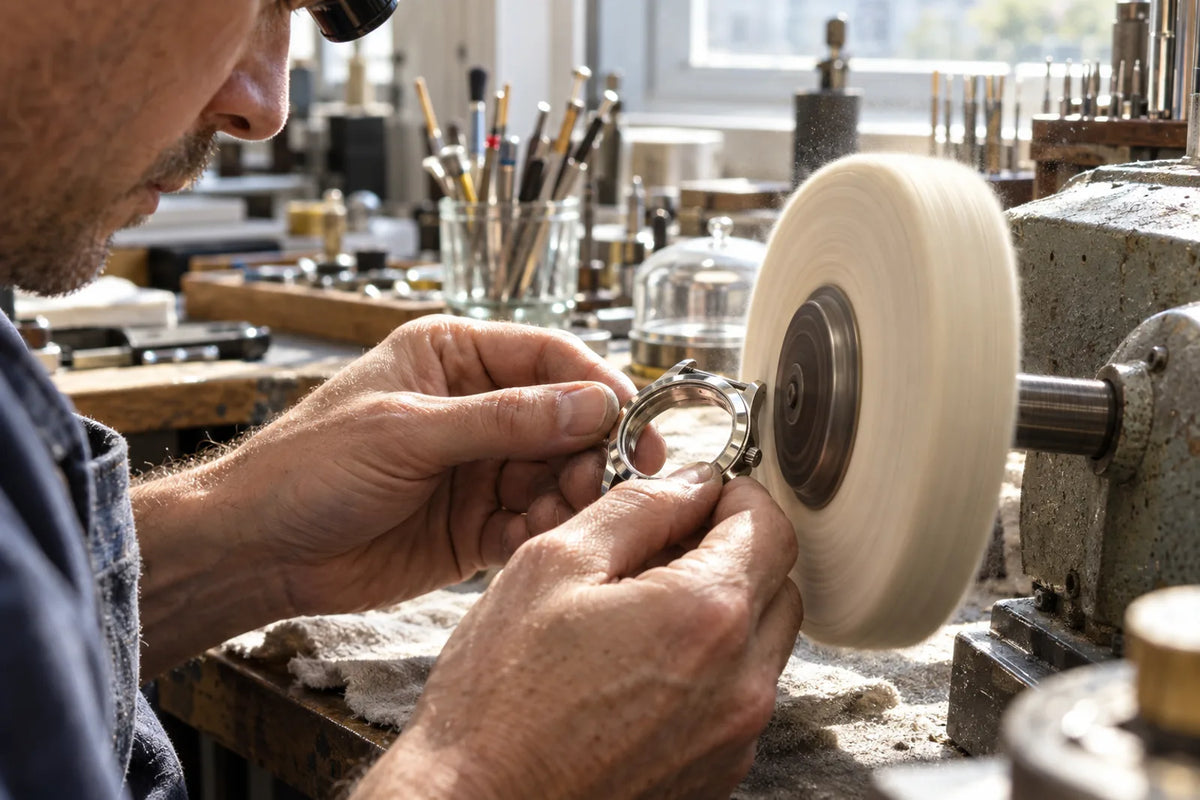
- Light buffing. A gentle pass with a soft compound that brings back the shine and softens micro-scratches while removing very little material.
- Full polishing. Reworking every surface, polished or satin-brushed, to remove deeper marks. This is what uses up the budget.
- Laser welding. Adding welded metal into a deep dent before finishing. Longer and more expensive, it is reserved for damage that polishing alone would dig too deeply into.
The word "polish," often heard at the counter, covers all three. That is why it matters to have the quote specify which one is included.
A complete service is when polishing costs the least
In brief: During a complete service, the case is disassembled and the gaskets are replaced, so polishing can be added without any risk to water resistance.
Patek Philippe's servicing procedure describes the order of operations. The external components are "disassembled, checked, cleaned and, at the client's request, polished." The timepiece then goes through 14 days of quality control, water resistance included. At Rolex as at Audemars Piguet, polishing is also requested at the time of a complete service.
Outside a service, polishing the case sides and lugs means removing the bracelet, often the bezel, then changing the gaskets and redoing the water resistance test.
The math for a modern Submariner, with a six-digit reference, according to Rolex's Canadian price list:
- complete service: $980 CAD;
- optional polishing and satin-finishing: $210 CAD;
- total: $1,190 CAD before taxes, with a free quote. As it happens, that is the price of a service alone on a Daytona, polishing not included.
The age of the reference changes the line. Classic models, with five-digit references, keep the $210 CAD option. Vintage models, with four-digit references, pay $420 CAD for it, on a service that starts at $2,090 CAD on the price list.
The pace follows that of servicing, which Rolex's FAQ puts at about every ten years, depending on the model and use. Polishing at every service, you reach Audemars Piguet's limit after 30 to 50 years; skipping every other service doubles that time. The calculation combines two brands and is meant as an illustration, not a manufacture rule.

Some watches are worth more with their scratches
In brief: On a vintage piece, a sought-after reference or a watch you plan to sell, original condition matters more than shine, and polishing is decided case by case.
A collector is not looking for a shiny case, but for intact proportions: lugs with sharp edges count for more than a scratch on the clasp.
Here is how to decide based on the watch in your hands:
|
Your watch |
Polish? |
What decides |
|---|---|---|
|
Modern, worn every day, surface scratches |
Yes, at the next service |
Light buffing or polishing is added to the service with no extra disassembly |
|
Deep dent on a lug or the bezel |
With caution |
Laser welding before finishing avoids hollowing out the lug |
|
Vintage or collectible |
No, unless an expert advises it |
The original edges and engravings carry the value |
|
Sale coming up |
No |
The buyer wants to judge the real condition, and the offer will not reimburse the polishing |
|
Ceramic bezel, PVD or DLC case |
No for those parts |
A scratch on ceramic rarely polishes out, and a polished coating disappears |
The line about selling often surprises people, but the guide to valuing a luxury watch confirms it: poorly executed polishing erases the original edges and lowers the value.
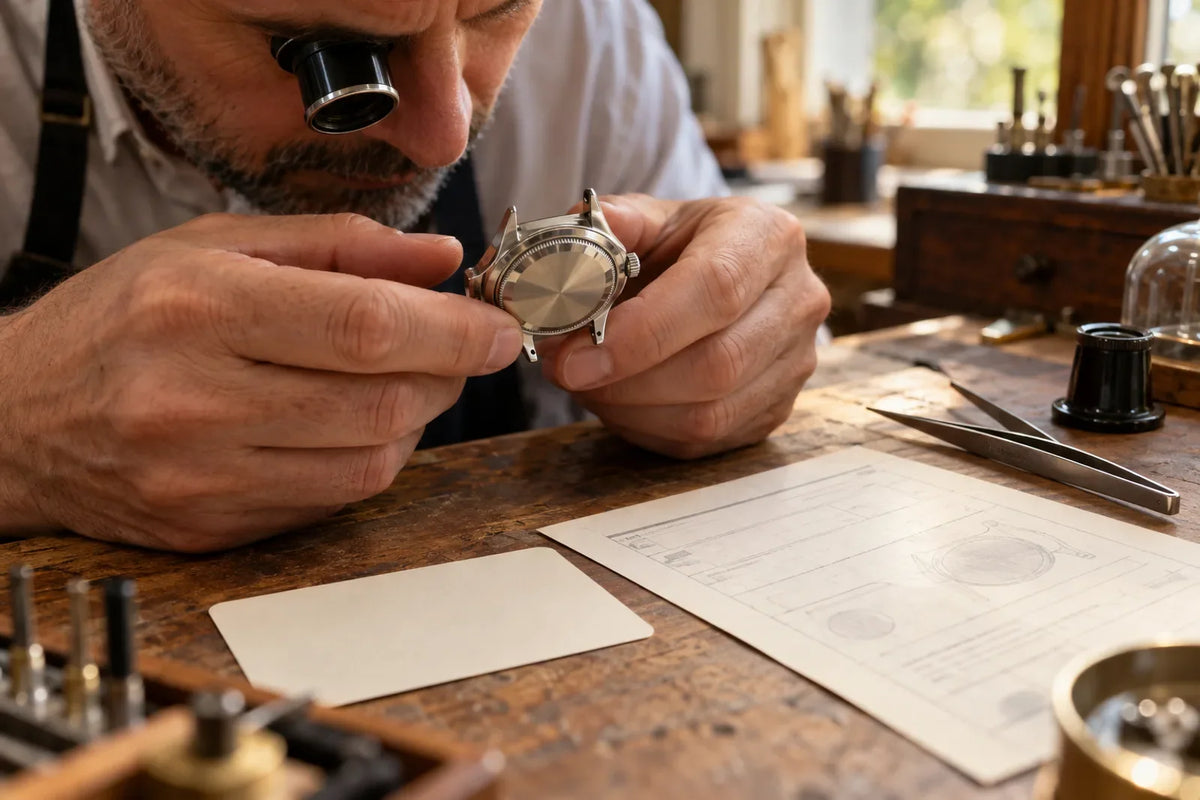
A scratch bothers you, but you are hesitant to touch the case? An examination first tells you whether the case can take another polish: see the expert watch services available before any work is done.
Read the polishing quote before the workshop touches the case
In brief: A good quote describes the level of polishing, the finishes to respect and the water resistance test, which leaves little room for misunderstandings.
Outside the brands' networks, there is no public price list to go by: independent polishing or laser welding is priced by quote, after examining the case, depending on the level of intervention and the surfaces to rework. To get one, see this polishing service in Montreal and its before-and-after photos.
A luxury watch restoration is judged by its finishes. On a Royal Oak, whose alternating satin-brushed surfaces and polished bevels are described in the guide to the 1972 icon, satin-brushing done in the wrong direction is visible from a metre away.
Before you sign, have the following specified in writing:
- The level of intervention. Light buffing, full polishing or laser welding, and on which parts.
- The original finishes. Which surfaces stay satin-brushed, which become polished again, and the direction of the brushing.
- The edges and bevels. A commitment to preserve them, rather than "flat" polishing that rounds everything off.
- The numbers and engravings. How they will be protected, especially between the lugs and on the caseback.
- Before-and-after photos. Under the same lighting.
- The water resistance test. After reassembly, with the result written on the invoice.

Between services, soapy water beats polishing paste
In brief: Polishing kits sold online attack the edges and blur the finishes, while gentle cleaning is all you need between workshop visits.
Rolex's FAQ sets out what to do: a microfibre cloth from time to time, and soapy water with a soft brush for the case and metal bracelet, with the crown screwed down tight. The same page specifies that, for a Rolex, professional polishing should only be done at an official Rolex service centre.
Abrasive cloths and "scratch remover" pastes spill over from a satin-brushed surface onto a polished edge. The bracelet ends up neither shiny nor matte, and only a workshop can fix that mix.
Deciding on luxury watch polishing one service at a time
One question settles it at every workshop visit: how many passes has the case already had? A modern watch worn every day benefits from light buffing at every service, and full polishing at every other service. A vintage piece, a sought-after reference or a watch you will soon sell keeps its marks. The rest is settled in the quote, line by line.
Before the next service, have the case examined to find out what it can still take. Booking an appointment for an examination gives you an answer based on the watch itself rather than on a photo.
FAQ
How much does luxury watch polishing cost?
It depends on the brand and the age of the watch. At Rolex in Canada, according to the October 2026 price list, luxury watch polishing costs $210 CAD on a modern or classic model and $420 CAD on a vintage one. It is added to the complete service, billed at $840, $980 or $1,190 CAD depending on the modern model, polishing not included. Outside the brand network, polishing or laser welding is priced by quote.
Can a watch crystal be polished?
Sometimes. An acrylic crystal, fitted on many older watches, can be polished and is easy to replace: Rolex counts it among the parts included in its complete service. A sapphire crystal, much harder, resists everyday scratches, but a deep mark will not polish out. It is then replaced, ideally during a service, since the case has to be opened and its water resistance checked again.
Does polishing reduce a watch's value?
Sometimes. On a common modern watch, well-executed polishing during a service has little effect on the price. On a vintage piece or a highly sought-after reference, rounded edges and softened engravings lower the offer, because the buyer is paying for original condition. Before a sale, present the watch as it is, with its scratches and its service history, and let the buyer judge.
How often should a luxury watch be polished?
Rarely. Audemars Piguet recommends no more than three to five cosmetic refreshes over a watch's entire life. The safest time is the complete service, which Rolex recommends about every ten years depending on the model and daily use. A watch worn every day can get light buffing at every service and keep full polishing for every other service.