Buying guide to a Cartier watch in Canada
Choosing a Cartier watch in Canada rests on five criteria: verified authenticity, documented provenance, exact condition and reference, a good fit between size and wrist, and a realistic budget. Choose a seller who authenticates every timepiece and provides a written warranty before you buy.
Acquiring a timepiece signed by this house means investing in a piece of watchmaking sought after on the Canadian market as much as internationally. Between historic silhouettes and modern reissues, the offering is vast, and the price gaps are real. This guide explains the concrete criteria for buying with confidence, spotting the pitfalls, and coming away with a model that holds its value.
Why choosing a Cartier watch matters
A buying mistake is costly. In this segment, counterfeits are well made, false “good deals” circulate, and a model without papers loses a significant share of its resale value. A poor choice can also mean an ill-fitting piece that stays in the drawer, or a discontinued reference paid for at the price of new.
Conversely, a well-considered acquisition becomes a lasting asset. Flagship silhouettes remain highly sought-after, which protects your investment and makes resale easier. The seller's quality and the piece's traceability therefore matter as much as the model itself.
Authenticity, the first criterion to confirm
Authenticity comes before everything else. Demand an inspection by qualified watchmakers: open the case, check the movement, and verify the consistency of the finishing, engravings, and serial numbers. A serious intermediary will do this check and document it in writing.
Be wary of listings without detailed photos of the movement, case back and hallmarks. An authenticated piece comes with a written warranty attesting to its compliance. Without that safety net, the risk falls entirely on you.
Provenance and the papers to demand
Provenance tells the watch's story. Ask for the original invoice, the warranty card, the box and the full service history. These elements confirm the production year and reassure the next buyer.
A “full set” piece, complete with its original accessories, negotiates better than a case alone. On the secondhand market, this paper trail often makes the difference between a fair price and a discount. The secondary market guide details buying channels and the checks to carry out.
Condition, reference and movement
Check the actual condition: scratches, over-polishing, bracelet play, timekeeping accuracy. Overly aggressive polishing rounds off the edges and reduces the value of a sought-after piece.
The exact reference matters too. Each model carries a number that identifies the vintage, format and material. This reference lets you compare equivalent listings and avoid mistaking a recent reissue for a rarer, historic version.
Size, materials and style on the wrist
An iconic watch, first and foremost, has to suit you. Measure your wrist and compare it with the available sizes: small, medium, large, or XL. An overly large case throws off the silhouette; a model that's too discreet gets lost.
As for materials, steel remains versatile and legible, gold and two-tone add flair, and gem-set versions aim for showpiece status. Think about everyday use, bracelet type and clasp before deciding.

Cartier watch types to know
The house structures its offering around recognizable families, none inherently “better” than another: the choice depends on your style.
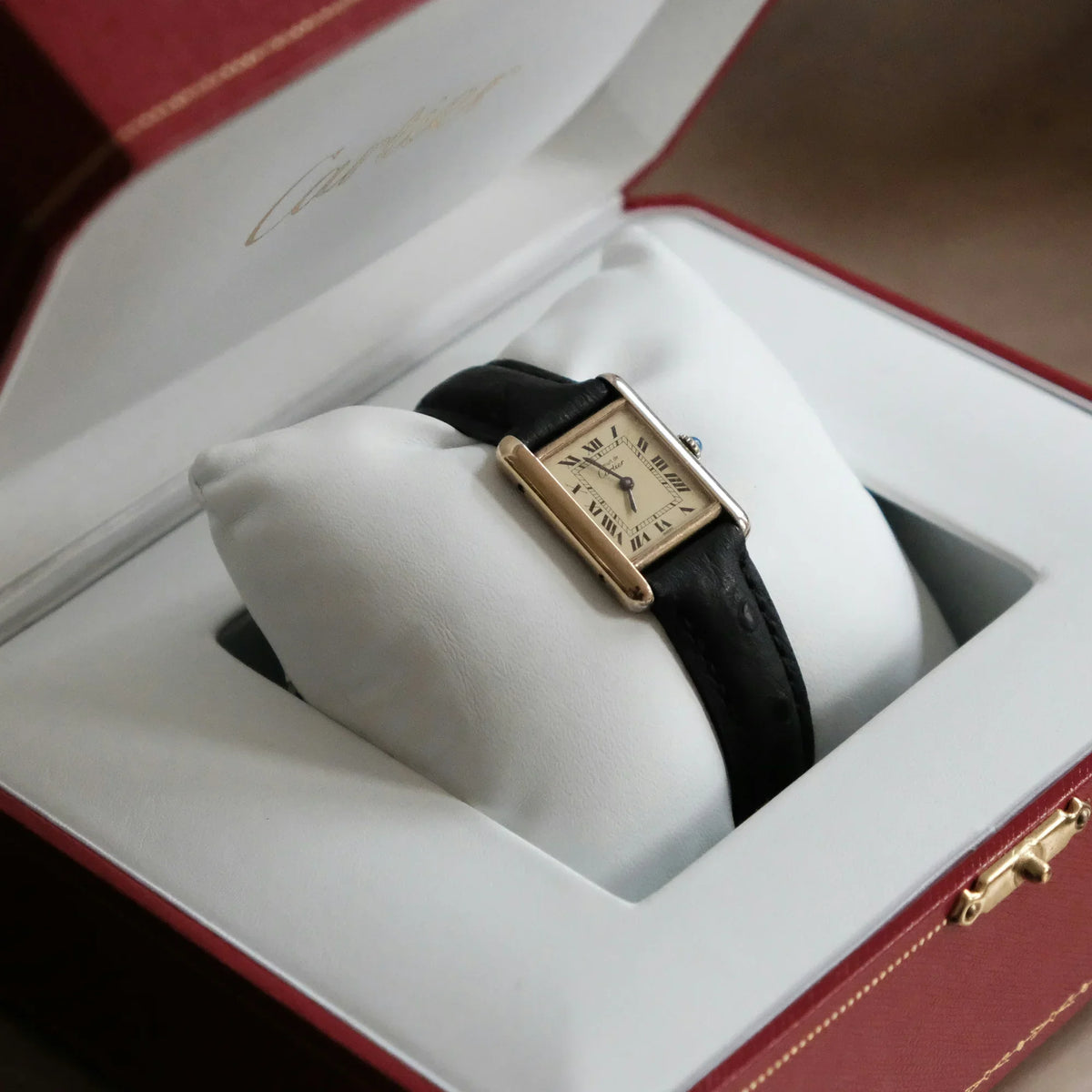
- Tank: a rectangular case born in 1917, inspired by the aerial view of Renault tanks, according to the Tank's origins. Classic elegance, very wearable. Worth seeing: the Tank Must model in steel.
- Santos: square with exposed screws, presented as the first modern wristwatch, created in 1904 for aviator Alberto Santos-Dumont. Sporty, assertive style, like the large steel Santos.
- Panthère: a jewellery-like silhouette with a supple bracelet, highly prized in steel, such as the large steel Panthère.
- Ballon Bleu: a round case recognizable by its crown protected by a cabochon.
Common mistakes to avoid before buying
Haste is the enemy of a good deal. Buying without papers, authentication, or photos alone exposes you to unpleasant surprises. A price noticeably below market should raise a flag rather than tempt you.
Another pitfall: ignoring the reference and vintage, which leads to overpaying for a common reissue. Finally, neglecting after-sales service, the warranty, servicing and parts availability complicates the owner's life down the road.
|
Criterion |
What to check |
Why it matters |
|
Authenticity |
Movement inspection, hallmarks, serial numbers |
Rules out counterfeits and protects value |
|
Provenance |
Invoice, warranty card, box, history |
Confirms the vintage and eases resale |
|
Condition and reference |
Polishing, timekeeping, exact model reference |
Avoids overpaying for a common version |
|
Size and materials |
Case format, wrist size, steel or gold |
Ensures comfort and everyday wearability |
|
Budget |
Market price comparison, warranty included |
Prevents false bargains and discounts |
Torn between several formats or families? Have a specialist dealer authenticate the piece and ask for a written valuation before committing; it is the best way to buy at a fair price with peace of mind.
Quick buying checklist:
- Confirm written authentication and a compliance warranty.
- Gather the invoice, card, box and service history.
- Note the exact reference and production year.
- Try the format on your wrist before deciding.
- Compare the asking price with equivalent listings.
Conclusion
Choosing a Cartier in Canada isn't a snap decision: authenticity, provenance, condition, format and budget form the decision framework that protects your purchase and its resale value. The Tank, Santos, Panthère and Ballon Bleu families each offer a distinct signature, to weigh against your style and actual use. Take the time to check each point, then contact a specialist dealer to authenticate the piece and get a written valuation before finalizing.

FAQ
How can you recognize a genuine Cartier watch when buying?
A genuine Cartier watch is recognizable by the careful finishing of its case, the precise engraving of its serial number, the consistency of its movement and the quality of its dial. Demand an inspection by qualified watchmakers, a written warranty of compliance and, ideally, the original papers. An abnormally low price or missing documentation should always raise a red flag.
Where can you buy a Cartier watch in Montreal with confidence?
Favour a specialist dealer who authenticates every piece, documents its provenance and provides a written warranty. Compare condition, reference and price against equivalent listings. An in-person consultation lets you try the format on your wrist and confirm authenticity before committing, which greatly reduces the risk in this market.
Should you choose a new or used model?
New offers complete peace of mind and full warranty coverage, but at a premium price. Used gives access to rare or discontinued references, often at a better price, provided you demand rigorous authentication and a written warranty. The choice depends on your budget, the model in mind and your risk tolerance.
Which case size should you favour?
Measure your wrist size first, then compare it against the sizes on offer: small, medium, large or XL. A case that's too large throws off the silhouette; a format that's too discreet gets lost. Try several sizes before deciding, and factor in the bracelet type, which strongly affects everyday comfort.
Do iconic watches hold their value?
Historic silhouettes benefit from steady demand, which protects your investment provided you buy an authentic, complete piece in good condition: original papers, the exact reference and consistent servicing support resale value. A poorly documented or over-polished piece, on the other hand, sees a noticeable discount on the market.