Tudor in Canada, buying guide to Rolex's sister brand
To choose a Tudor watch in Canada wisely, first check the COSC-certified in-house movement, authenticity, and provenance, then condition, reference, and budget. Understanding the family ties with Rolex helps gauge value, while a transparent seller keeps every purchase in Quebec secure.
Buying a Swiss watch is both a financial and an emotional commitment. Rolex's sister brand appeals through its value for money, its diving heritage, and its modern calibres. Still, you need to know what to look for before pulling out your card. This guide breaks down the concrete criteria, model families, and classic mistakes, so your decision rests on facts, not a poorly informed impulse.
Why choosing your watch carefully changes everything
A poor purchase is costly, and not just at checkout. A piece that's poorly authenticated, a model that doesn't fit your wrist, or a reference nearing the end of its cycle can lose value quickly or become hard to resell.
Conversely, a well-thought-out choice protects your investment. The company, founded in 1926 by Hans Wilsdorf, Rolex's creator, now belongs to the Hans Wilsdorf Foundation, as noted in its public encyclopedia entry. This lineage guarantees high standards, but every reference has its own particularities that need to be assessed individually.
The in-house movement, the heart of the choice
The first technical criterion remains the movement. Historically, the brand fitted its watches with reliable but external ETA calibres. Since 2015, it has produced its own in-house calibres, a shift that changes things for the buyer.
These movements offer a power reserve of around 70 hours, an antimagnetic silicon balance spring, and chronometer certification, as detailed on the official page for COSC-certified in-house calibres. Since 2024, some pieces carry the even more demanding METAS Master Chronometer certification.
So check whether the model you're eyeing runs an in-house calibre or an external movement: this affects precision, upkeep, and perceived value.
Authenticity and provenance above all
On the pre-owned market, authenticity comes first. A serious seller carries out a full inspection, documents the reference, and clearly presents the piece's condition.
Ask for the original papers, the warranty card, and, where applicable, the service history. The case, dial, and bracelet must match the stated reference. In Montreal as elsewhere in Canada, favour a recognized broker who stands behind the traceability of their watches.
The same logic applies to the parent brand: the Rolex broker guide illustrates well how important a transparent intermediary is in Quebec.
Properly assessing a pre-owned Tudor watch
Condition determines the fair price. Examine wear on the case, any deep scratches, how the crown and bezel operate, and the date of the last service.
A recent, complete piece, with box and papers, negotiates and resells more easily than a bare, undocumented model. The exact reference matters too: certain limited or discontinued series hold their value better.
Set a realistic budget before shopping around. Prices vary by collection, condition, and availability, and many sought-after pieces are listed as "price on request."
Collections and types of models available
The lineup breaks down into a few families, each with its own purpose. Understanding these categories keeps you from buying a model unsuited to your needs.
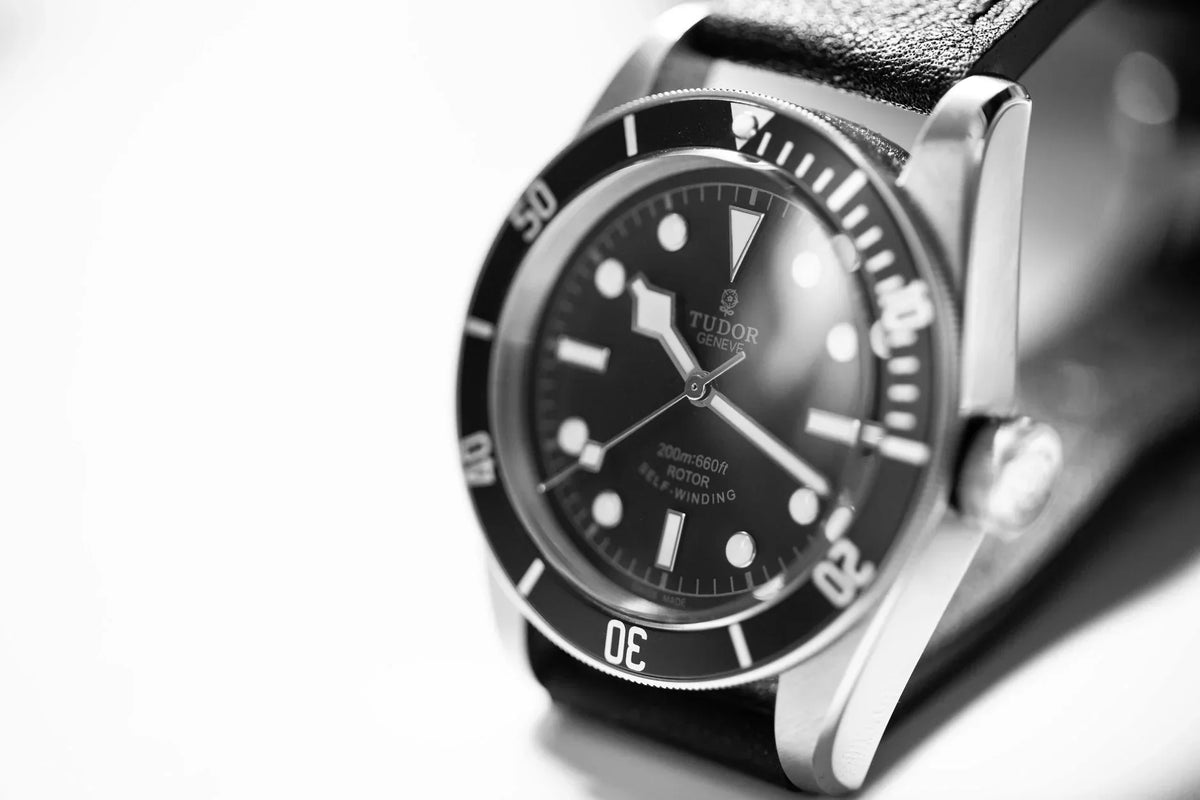
- Black Bay: the best-known heritage dive line, launched in 2012, available in three-hand, GMT, and chronograph versions, such as the Tudor Black Bay watch.
- Pelagos: a technical titanium diver, geared toward performance and durability.
- Ranger: an understated field watch, whose name dates back to 1929.
- 1926 and Royal: more classic, dressier lines for elegant everyday wear.
Choose first based on actual use: diving, everyday versatility, or dressy wear. Case size and bracelet type should follow from that decision.
Take action at the right moment
Before finalizing, compare at least two equivalent pieces and ask a specialist all your questions. Explore a verified selection and have the model you're interested in authenticated before making any commitment.
Common mistakes to avoid
A few pitfalls keep coming up among buyers in a hurry. Spotting them ahead of time saves you both time and money.
- Relying on price alone without checking authenticity or provenance.
- Overlooking the exact reference and production year.
- Forgetting to ask for the box, papers, and service history.
- Confusing an older external calibre with a recent in-house one.
- Buying without trying the case size on your wrist.
The same rigour that applies to dive watches applies here too: the Rolex Submariner guide shows how references and technical details guide an informed purchase.
Comparison of buying criteria
|
Movement |
In-house or external calibre, COSC or METAS certification |
Precision, upkeep, and perceived value |
|
Authenticity |
Seller's inspection, consistency of case and dial |
Avoids counterfeits and unpleasant surprises |
|
Provenance |
Papers, warranty card, history |
Traceability and easier resale |
|
Condition |
Wear, recent service, functioning |
Fair price and mechanical reliability |
|
Reference |
Exact model, year, series |
Direct impact on resale value |
|
Budget |
Realistic range based on the collection |
A calm decision, without overpaying |
Keep this checklist in mind on every store visit or every exchange with a broker.

Conclusion
Choosing a Tudor watch in Canada comes down to weighing four benchmarks: movement, authenticity, condition, and reference, all set against the heritage of Rolex's sister brand. A transparent seller and a well-documented piece are always worth more than a dubious bargain. Take the time to compare, check the papers, and try the model on. To go further, ask a specialist for advice before confirming your purchase with confidence.
FAQ
Why buy a Tudor watch instead of a Rolex?
The brand shares Rolex's, its sister company's, standard of quality while remaining more accessible. Since 2015, its COSC-certified in-house calibres offer a power reserve of around 70 hours and a silicon balance spring. You get sturdy Swiss watchmaking, a distinctive design, and excellent value for money, without giving up a serious heritage or great everyday usability.
How do you verify the authenticity of a pre-owned piece?
Have the verification done by a recognized broker, who checks the consistency between the reference, case, dial, and movement. Require the original papers, the warranty card, and, where applicable, the service history. A transparent seller accurately documents the actual condition and doesn't hesitate to answer your technical questions. This diligence protects your investment and makes it easier to resell at the best possible price.
Which collection should I choose based on my use?
For diving or a sporty style, the Black Bay and the Pelagos dominate, the latter in titanium for durability. For an understated field look, the Ranger fits perfectly. For a dressier office look, turn to the 1926 or Royal lines. Determine your actual use first, then adjust case size and bracelet type accordingly.
Where can you find these watches in Montreal and across Canada?
Go through a broker or specialized dealer who authenticates every piece and ensures the traceability of their stock. An intermediary established in Montreal simplifies inspection, try-ons, and negotiation, while serving all of Canada. Check the seller's reputation, the clarity of their terms, and the quality of their after-sales service before committing to an amount, often provided on request.