Which model to choose between the Rolex Submariner and the GMT-Master?
The differences between the Rolex Submariner and the GMT-Master mainly come down to function: the Submariner is a diving watch water-resistant to 300 metres, while the GMT-Master displays a second time zone. Choose the Submariner for underwater durability, the GMT-Master for travel.
These two icons from the manufacturer share an almost identical case and the same reputation for reliability. Yet they were designed to master two opposite worlds: the depths of the ocean on one side, and the sky and time zones on the other.
Understanding what sets them apart helps settle the well-known Submariner-or-GMT dilemma, not based on trends, but on the real use you'll make of the watch day to day.
Overview of the two watches compared
The Rolex Submariner is a diving watch introduced in the mid-1950s. Designed for divers, it focuses on maximum readability, a rotating dive bezel, and high water resistance. Its dial displays three hands, with no unnecessary complications, making it a model known for its rugged simplicity.
The GMT-Master, whose modern version is the GMT-Master II, was born shortly after, in collaboration with an airline, to help pilots track multiple time zones. Its signature feature is a fourth hand paired with a bezel graduated over 24 hours, often bicoloured. It's a travel watch recognized for its versatility.
Comparison criteria used
Since no specific criteria were imposed, the comparison relies on logical and transparent benchmarks, the ones that matter most when buying a tool watch from the brand:
- Function and complication (real-world use of the watch)
- Bezel and dial readability
- Water resistance and durability
- Size, comfort, and style on the wrist
- Perceived value and desirability on the secondary market
Each following section compares the two models on one criterion at a time, in a neutral manner. For additional external analysis, this detailed model comparison covers several of these points.
Function and complication
This is the most important distinction. The GMT-Master displays a second time zone thanks to its 24-hour hand and graduated bezel. On the GMT-Master II, the local-hour hand can be set independently, allowing the wearer to change time zones without stopping the movement.
The Submariner, for its part, focuses on one thing only: telling time underwater with absolute clarity. It deliberately avoids any complication that could compromise readability or durability. Two philosophies, two uses.
Bezel and readability
The bezel reveals each watch's DNA. The Submariner's is unidirectional and graduated over 60 minutes: it only turns one way, so the diver can never overestimate their remaining immersion time. A simple and vital device.
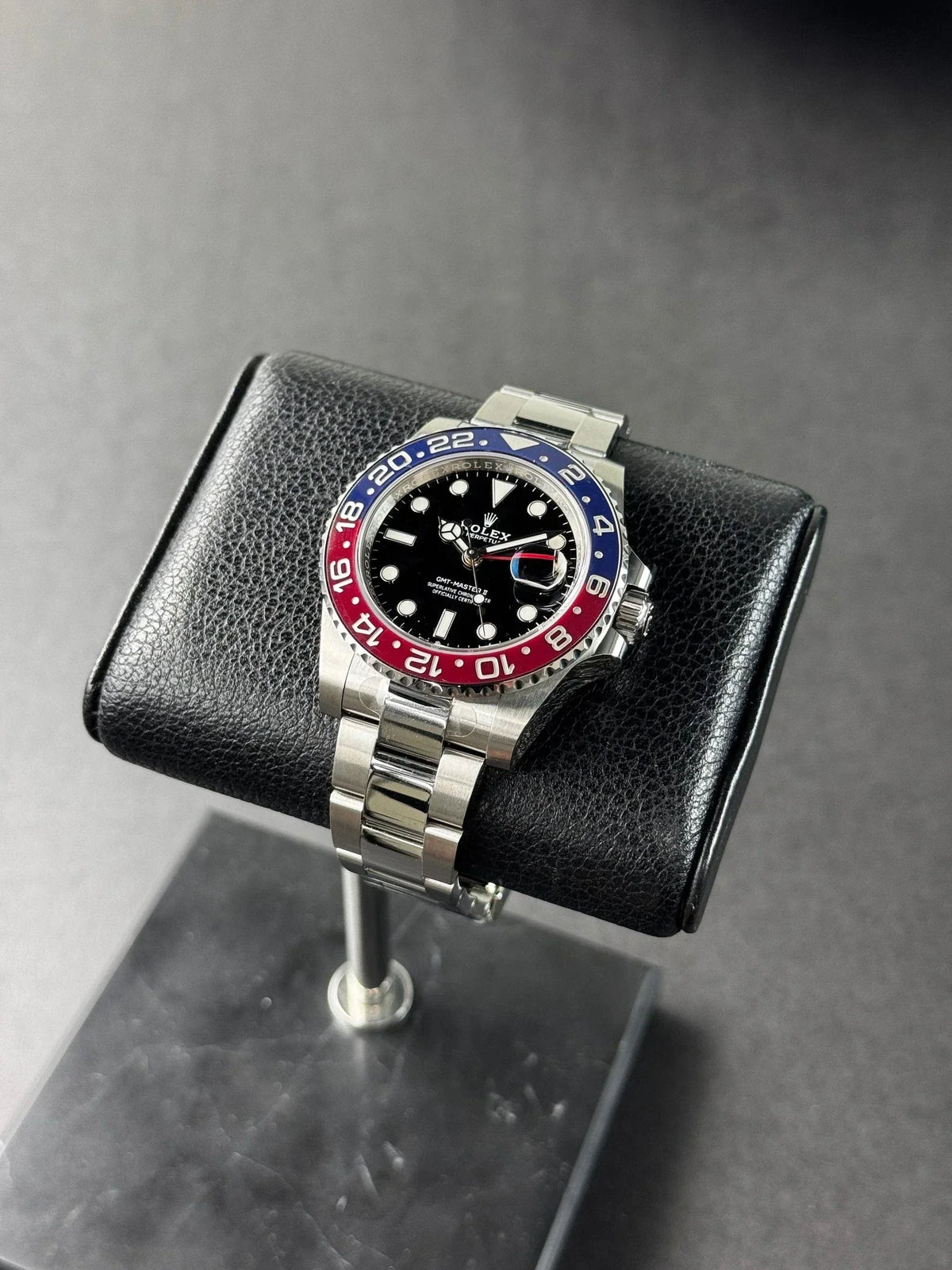
The GMT-Master's bezel is bidirectional and graduated over 24 hours. Combined with the fourth hand, it lets you read two time zones at a glance. On the dial side, the Submariner stays clean with three hands, while the GMT-Master adds an arrow-shaped hand, often in colour.

Water resistance and durability
Both models use the same screw-down crown with a triple waterproofing system, a mark of seriousness. But their rated depths differ significantly.
The Submariner is water-resistant to 300 metres, built for professional diving. The GMT-Master offers water resistance of 100 metres, more than enough for everyday life and travel, but less suited to underwater exploration. If water is central to your use, the gap clearly favours the diving watch.
Ready to move from comparison to hands-on trial? Explore the available references and request an expert consultation to confirm each piece's authenticity before you buy.
Size, comfort, and style
Both watches sit in a similar size range, though they aren't identical. The modern Submariner is worn in 41 mm since its update, while the GMT-Master II retains a 40 mm case. The on-wrist feel stays very close, with the same versatile tool-watch profile.
Style sets them apart more. The Submariner plays it monochrome and understated, easy to match. The GMT-Master embraces colour with its two-tone bezels, like the GMT-Master Pepsi model or the green Sprite version, more expressive for everyday wear.
Value and desirability on the market
Both collections rank among the brand's most sought-after and retain strong desirability on the secondary market. The Submariner, often cited as the reference diving watch, remains a recognized entry point into the brand.
Certain coloured GMT-Master variations are particularly coveted and can command a notable premium, as this collector analysis points out. Exact prices vary by reference and condition and should be confirmed with the seller at the time of purchase.
Comparison table of the two models
|
Criterion |
Rolex Submariner |
GMT-Master |
|
Main function |
Diving watch, simple time |
Second time zone (dual time) |
|
Complication |
Three hands, no complication |
Fourth hand, 24-hour |
|
Bezel |
Unidirectional, 60 minutes |
Bidirectional, 24 hours |
|
Water resistance |
300 metres |
100 metres |
|
Case size |
41 mm (modern version) |
40 mm |
|
Dominant style |
Understated, monochrome |
Colourful, two-tone bezels |
|
Ideal use |
Water, durability, everyday |
Travel, multiple time zones |
Which one to choose based on your profile
There's no single winner: the right choice depends on your habits and priorities.
- Choose the Rolex Submariner if you dive, do water activities, or want maximum durability with a discreet, versatile style.
- Choose the GMT-Master if you travel often, manage multiple time zones, or enjoy a bold touch of colour on your wrist.
- Opt for the Submariner if you want the simplest, most legible tool watch, without a function you'd never use.
- Opt for the GMT-Master if the dual time-zone function is useful to you at least a few times a year and justifies its presence.
For a first purchase focused on water and understatement, a steel Submariner Date checks a lot of boxes, while a travel enthusiast will lean toward the GMT variations. The complete Submariner buying guide also helps pinpoint the right references.
Conclusion
In the end, the differences between the Rolex Submariner and GMT come down to use rather than prestige. The Submariner dominates whenever water and simplicity come first, while the GMT-Master stands out for those who cross time zones. Both offer the same build quality and lasting desirability, which explains the ongoing dilemma between the Submariner and the GMT. Compare the models in person and have specialists validate your choice before finalizing your purchase.
FAQ
What are the differences between the Rolex Submariner and GMT?
The differences between the Rolex Submariner and GMT mainly concern their functions. The Submariner is a diving watch, water-resistant to 300 metres, with three hands and a unidirectional bezel. The GMT-Master adds a fourth hand and a 24-hour bezel to read a second time zone. The former targets water and durability; the latter, travel and versatility across multiple countries.
Can the GMT-Master be used as a diving watch?
The GMT-Master resists water up to 100 metres, which is plenty for swimming, showering, and everyday life. However, it isn't designed as a professional diving instrument. Its bidirectional bezel doesn't serve the safety role of a dive bezel. For regular diving, the Submariner and its 300 metres remain the appropriate and reassuring choice.
Does the Submariner come with or without a date window?
Yes. The collection offers a version with a date window and cyclops lens, as well as a version without a date window, with a cleaner, perfectly symmetrical dial. The choice mostly comes down to aesthetic taste and a preference for a minimalist display. Both retain the same diving purpose, the same unidirectional bezel, and the same high water resistance typical of the Submariner line.
Submariner or GMT for a first purchase from the brand?
The Submariner-or-GMT dilemma depends on your use. For a versatile, discreet, water-related first purchase, the Submariner is a recognized and timeless entry point. If you travel frequently or prefer a colourful bezel, the GMT-Master offers a clear function and bold character. Either way, have experts verify the authenticity and condition before you buy.